
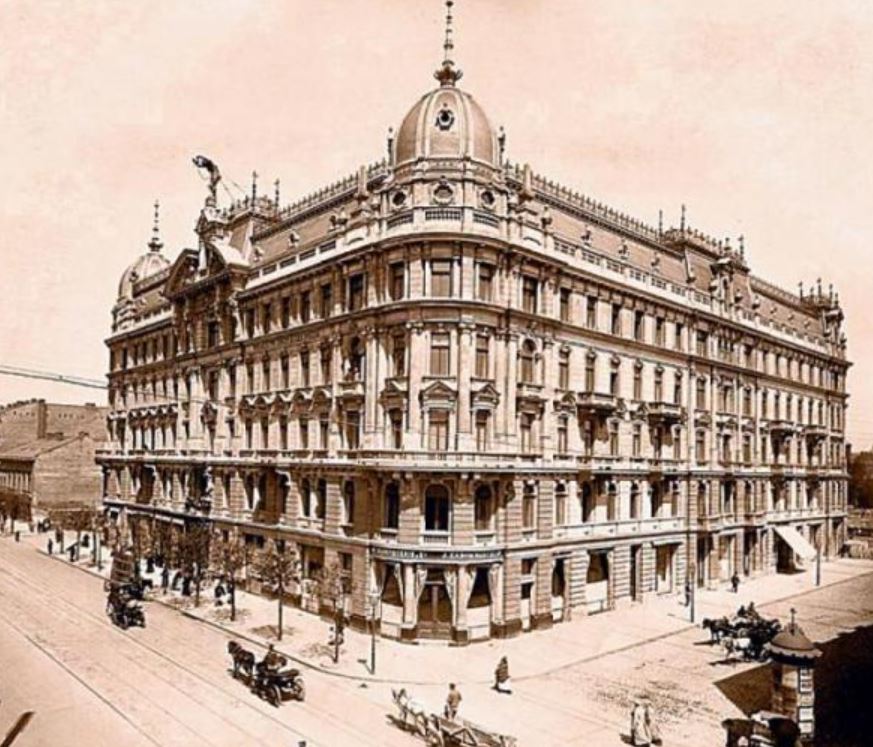
Witajcie, tym razem przedstawiam budynek, który w pewnym sensie istniej do dziś, ale jakże w zmienionej formie. Większość z nas go kojarzy ale pewnie mało kto wie jak pięknym gmachem był przed wojną…
Dom Towarzystwa Ubezpieczeniowego „Rosja” – bo o nim mowa to nieistniejąca obecnie kamienica, będąca wizytówką Marszałkowskiej (często pojawiająca się na przedwojennych zdjęciach ulicy). Teraz jest to budynek PKO, w górnej części zasłonięty reklamami tegoż banku.
Budynek wzniesiono w latach 1898–1899 według projektu Władysława Marconiego. Prawdopodobnie wzorowano się na wiedeńskim budynku „Ziererhof” projektu C. Königa.
Gmach, skomponowany z elementów włoskiego i francuskiego renesansu, wyróżniał się skalą i okazałością wśród zabudowy ul. Marszałkowskiej, poza tym był budynkiem bardzo nowoczesnym do którego budowy wykorzystano stal i beton.
Nowy gmach stał się siedzibą Towarzystwa Ubezpieczeń „Rosja”- stąd nazwa, a większość jego pomieszczeń przeznaczono pod wynajem – sklepy i biura, a wyższe kondygnacje na ekskluzywne mieszkania.
Spalony po Powstaniu został „odbudowany” w latach 1948–1950. Pozostawiając jedynie parter i dwa piętra od strony Marszałkowskiej, dobudowano kilka nowych pięter, niższych od poprzednich, elewację budynku wygładzono, a ocalałe piętra przesłonięto ażurową konstrukcją z otworami, które przyczyniły się do nadania mu przez mieszkańców Warszawy nazwy „dom pod sedesami”.
Pod koniec lat 90-tych zmieniono elewację budynku likwidując powojenne „sedesowe” otwory.
Przy okazji możecie zajrzeć do klatki schodowej głównego wejścia (po prawej stronie od Green Caffe Nero), która pozostała po dawnym gmachu (ocalały m.in. marmurowe schody i kute, żelazne poręcze).
Pierwsze zdjęcie pokazuje Budynek zaraz po wybudowaniu (przełom XIX i XX w.), następne w ciągu ulicy Marszałkowskiej od strony południowej i kolejne dwa od strony północnej. Pozostałe zdjęcia to już czasy powojenne i „dom pod sedesami” (ohyda!), następnie zdjęcie Google Earth oraz ostatnie – dzisiejsze czasy, zrobione z podobnej perspektywy co ostatnie – przedwojenne.
Hello everyone, this time I’m presenting a building that, in a sense, still exists today, but in a modified form. Most of us are familiar with it, but probably few know what a beautiful building it was before the war…
The „Rosja” Insurance Company House – the one I’m referring to – is a now nonexistent tenement house that was a landmark on Marszałkowska Street (often appearing in pre-war photos of the street). It’s now the PKO Bank Polski building, its upper section obscured by the bank’s advertisements.
The building was built in 1898–1899 according to a design by Władysław Marconi. It was likely modeled after the „Ziererhof” building in Vienna by C. König.
The building, composed of Italian and French Renaissance elements, stood out for its scale and grandeur among the buildings on Marszałkowska Street. It was also a very modern structure constructed using steel and concrete.
The new building became the headquarters of the „Rosja” Insurance Company—hence the name. Most of its rooms were designated for rentals, including shops and offices, while the upper floors became exclusive apartments.
Burnt down after the Uprising, it was „rebuilt” between 1948 and 1950. Leaving only the ground floor and two floors on the Marszałkowska side, several new floors, lower than the previous ones, were added. The building’s facade was smoothed, and the remaining floors were covered with an openwork structure with openings, which led to Warsaw residents dubbing it „the house under the toilets.”
In the late 1990s, the building’s facade was changed, eliminating the post-war „toilet” openings.
You can also take a look at the main entrance staircase (to the right of the Green Caffe Nero), which remains of the former building (including the marble staircase and wrought-iron handrails).
The first photo shows the building just after its construction (turn of the 20th century), the next along Marszałkowska Street from the south, and the next two from the north. The remaining photos are from the post-war period and the „house under the toilets” (disgusting!), then a Google Earth image, and the last one – present day, taken from a similar perspective as the last pre-war photo.